Summary
By switching from a paper flowboard to a digital flowboard, the Sabca Brussels plant has significantly streamlined the production monitoring of parts for the Airbus A350 program. All this in record deployment time. Wallboards for team rituals have also helped streamline communication.
Sabca: an aeronautics subcontractor… “condemned” to excellence
For a century, Sabca (Société Anonyme Belge de Constructions Aéronautiques) has established itself as one of the world’s largest suppliers of aeronautical equipment, with four main markets: defense, space, industry, and commercial aviation. From drones to Arianespace launchers, the group employs around a thousand people across four factories (three in Belgium, one in Morocco), the largest of which—and the one we’re interested in here—is located in Brussels.
Sabca Brussels: a major subcontractor of the A350 program
At this Brussels site (which is also its headquarters), nearly 700 employees work in the 105,000 m² factory to produce cantilevers, ribs, and levers—the parts that operate the flaps of the A350, Airbus’s large aircraft. This high-precision work is part of the incredibly complex industrial ballet that is the assembly of an Airbus: safety, quality, costs, and deadlines are non-negotiable!
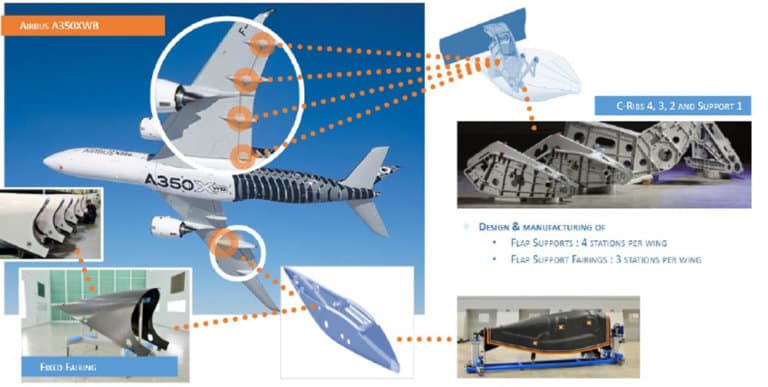
At any given time, the production backlog on the two lines of the Sabca-Brussels factory is approximately 80 parts, enough to equip five A350s. The factory operates Monday to Friday, from 6:30 a.m. to 10:30 p.m., in two shifts that must also be coordinated for smooth operations. In short: precise production monitoring is essential.
Paper production monitoring: precise, but so time-consuming…
The factory is, of course, equipped with an ERP system, which provides reliable information on the status of parts and structures in production. “But an ERP system doesn’t give you a global view of the health of your line,” emphasizes David Vermoesen, “that’s not its job.” It’s also not designed to provide this visibility to all stakeholders in the chain, and access to it is restricted.
To answer the question “where are we in terms of the progress of the parts to be produced”, David Vermoesen, the program operations manager, therefore created a flowboard, with several levels of information:
- Operator level
- Team leader level (workshop manager)
- Factory level
First, with a very simple process… on paper. A large synoptic spreadsheet diagramming the production lines and showing the progress of each part in production, which each team leader would then « point out » during the shift.
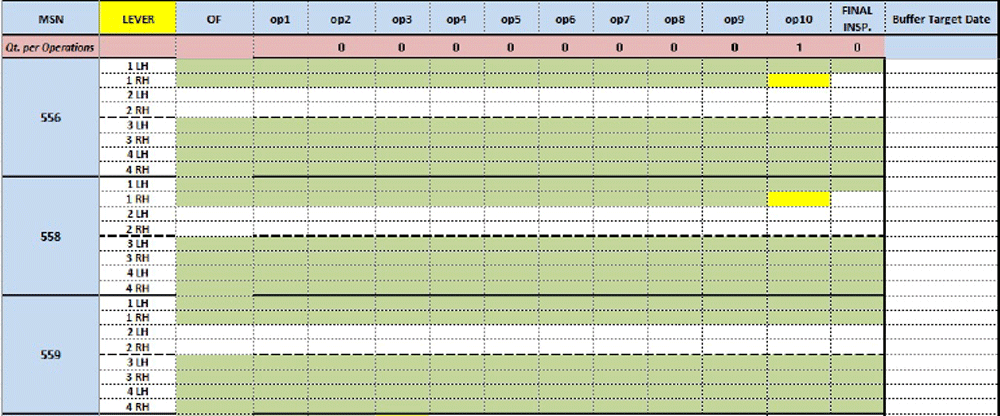
Simple? But not very efficient! “Do the math: import the ERP data into Excel, print the tables, have the team leaders fill them out for each of the 80 parts in production (and this over 2 shifts) and then manually enter the information into the spreadsheet… It took us a good 1 to 2 hours a day,” explains David Vermoesen. And if there’s one rare commodity in industry, it’s time!
Less time, fewer errors: the challenges of automating production monitoring
David Vermoesen quickly began looking for a solution that would allow him to automate the collection of field information.
What does he expect from it?
- Real-time monitoring of production progress (instead of having a snapshot of it per shift);
- The ability to better manage, or even anticipate, bottlenecks;
- Fewer errors (partly related to human input);
- And a significant time saving (for both the manager and the team leaders).
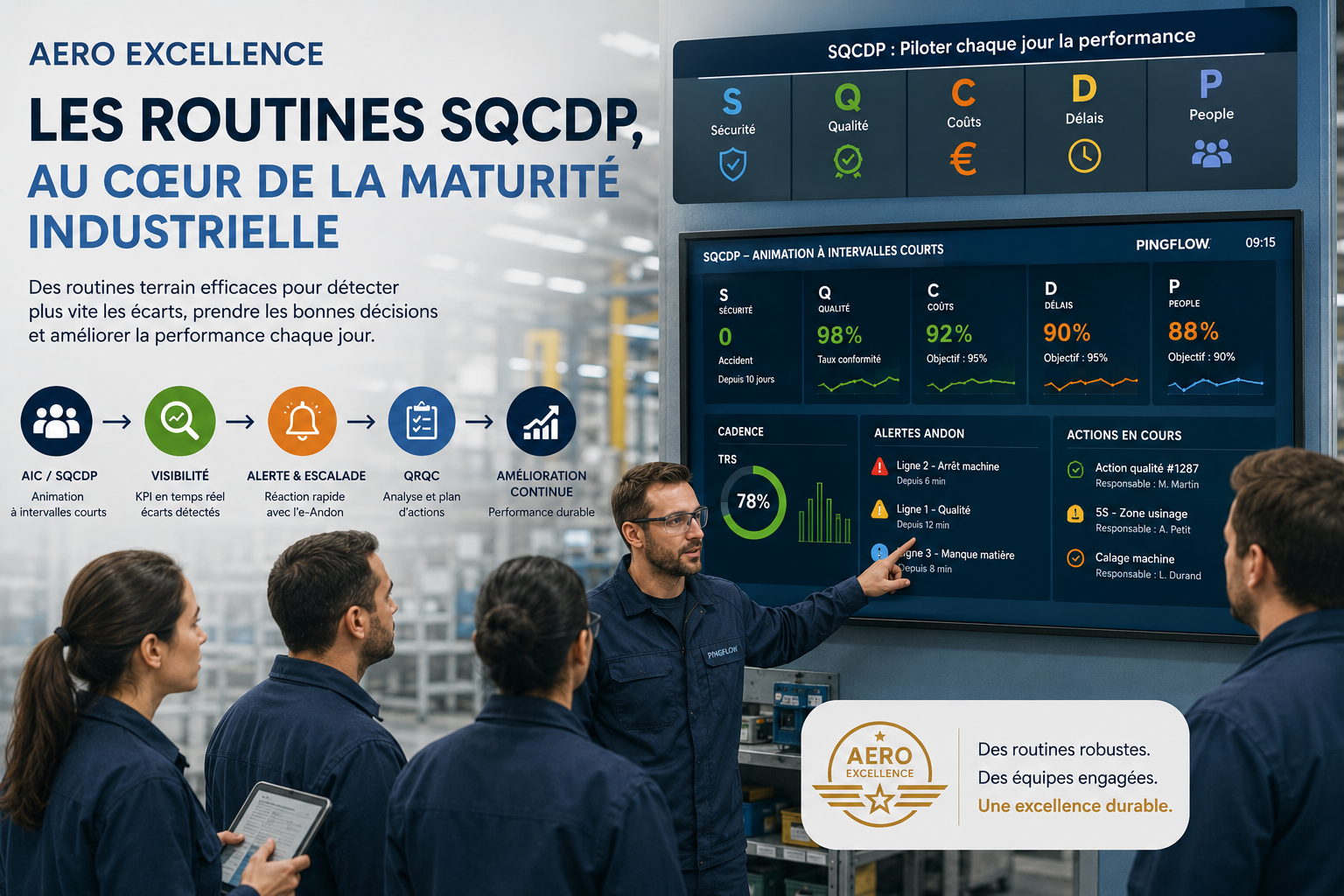
Lucky break: Sabca has been working on a project to digitize AIC (short interval animation) meetings with Pingflow for some time now. A potential partner to implement David Vermoesen’s idea has been found. All that’s left is to find the right partner!
The automated flowboard: gains for all links in the chain
The digital flowboard project will be deployed at… almost supersonic speed. Approached at the beginning of summer 2021, the Pingflow teams delivered an operational flowboard in September. “The Pingflow teams were ultra-responsive,” appreciates David Vermoesen. “But we were able to move forward all the faster because David’s expression of needs was extremely well-crafted and advanced,” retorts Christophe Zanetto, project manager and UX/UI Designer at Pingflow.
Pingflow’s contribution: challenging the user experience (UX)
Indeed, the expression of need was clear: based on his “manual” flowboard, David Vermoesen had already sketched out a first rendering of what he wanted. On this basis, the Pingflow teams proposed a more readable and dynamic version with:
- Immediate identification of « MSNs » (batches of parts in production corresponding to an aircraft)
- A clearer view of the progress of each batch based on the forecast schedule
- Visualization of the advance or delay in part production (thanks to color codes applied to the gauges)
“This wasn’t a clearly identified expectation on my part, and yet, this is where we realize the contribution of design and UX to an interface like this: Pingflow has really succeeded in making this flowboard much simpler and more efficient in transmitting information,” emphasizes David Vermoesen.
Sabca’s first digital flowboard project
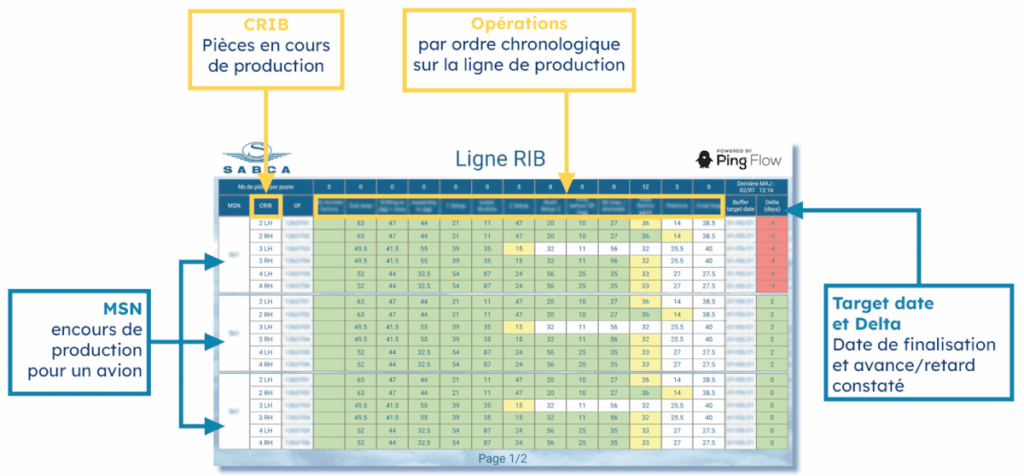
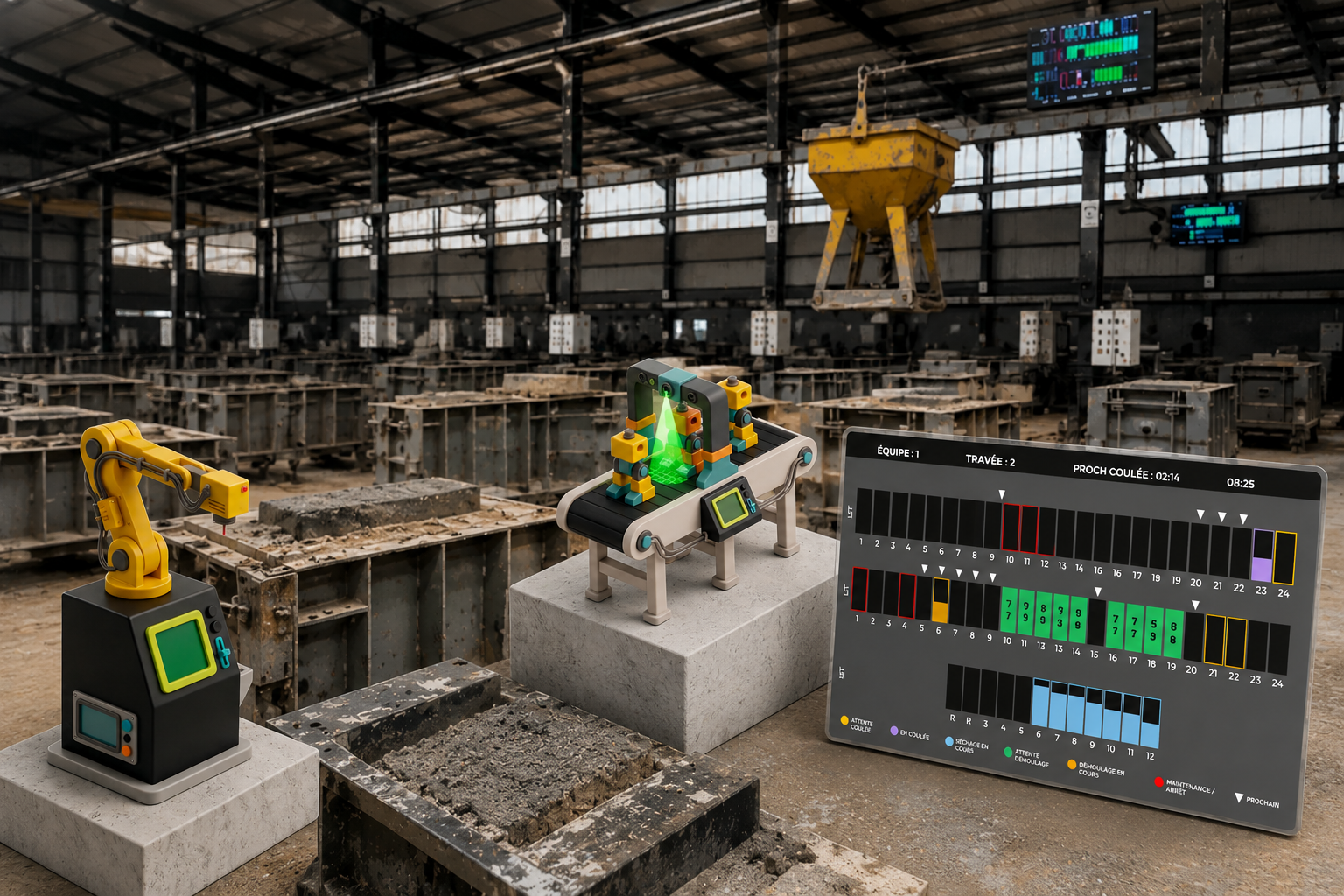
The final version of the flowboard proposed by Pingflow
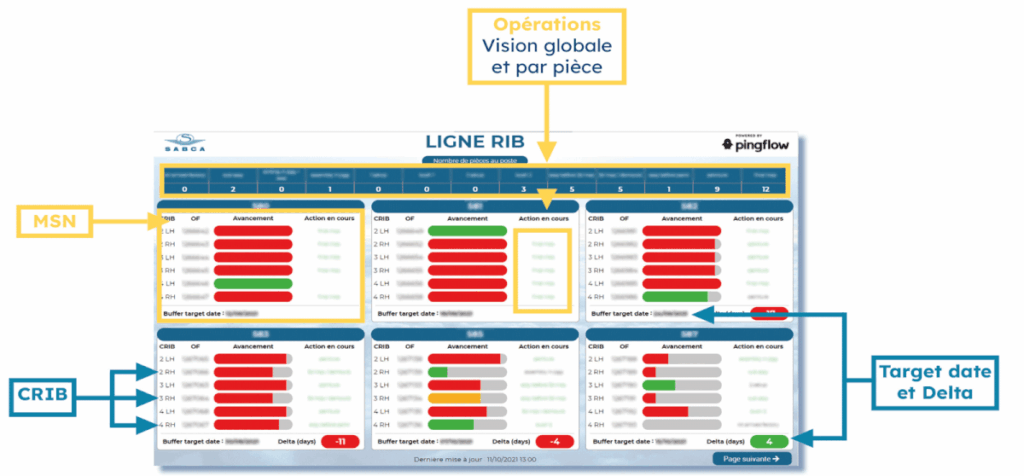
The result: an agile, near-real-time flowboard
With this rendering, which more clearly conveys the production progress of the various parts, the new flowboard easily won the support of operators and team leaders.
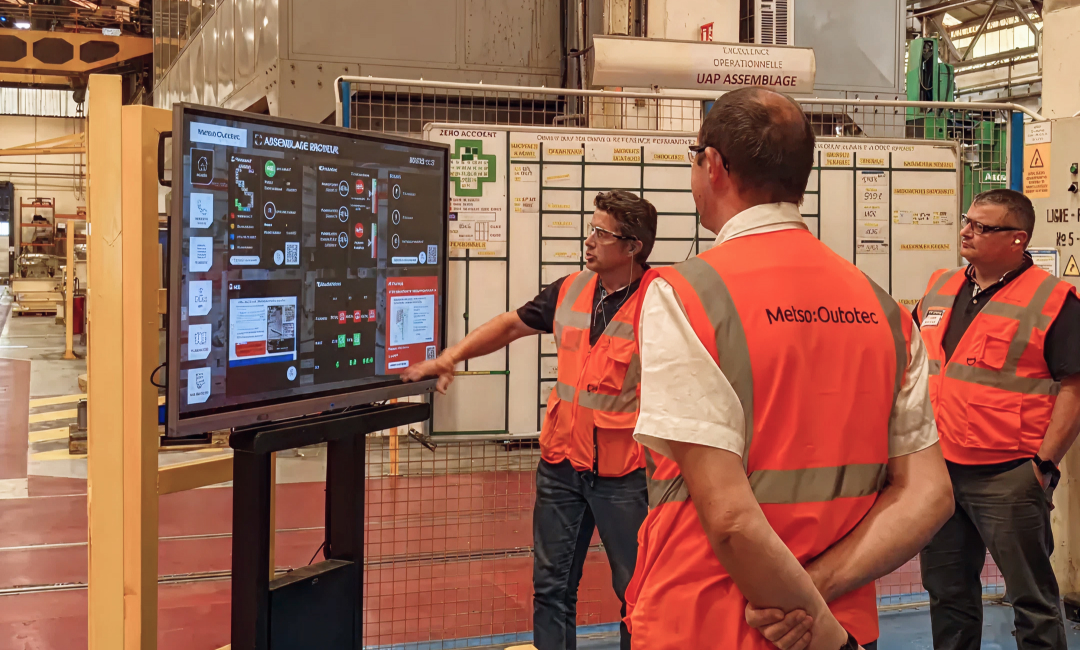
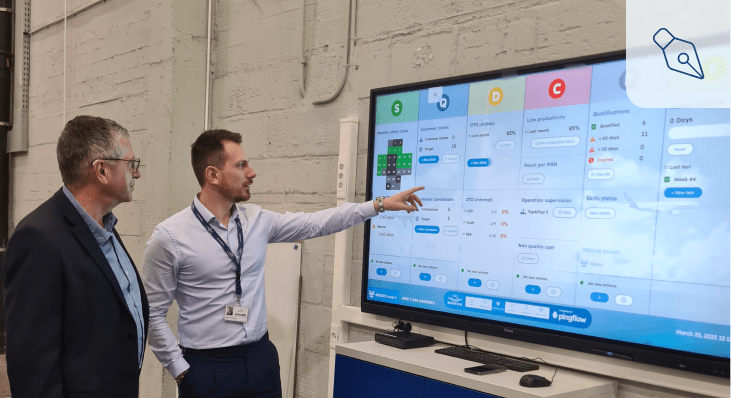
On the rib line (where the new digital flowboard is initially deployed), a large screen allows all teams to monitor production in near real-time (information updated every 30 minutes), while saving David Vermoesen and the team leaders the tedious step of timekeeping.
Because the main need was there, and the contract has been fulfilled: the team leaders now use the flowboard « live » as a production management tool, saving 1 to 2 hours per day on update time.
This real-time visibility offers a second benefit: it allows them to anticipate timekeeping or other problems on parts, and also improves response time when they occur. More responsive, less time-consuming, more readable: the project is a success! And we’re only just getting started…
Flowboards, a new asset for Sabca
Building on this successful POC, David Vermoesen plans to continue in two directions:
- Implement similar flowboards across all production lines at the Brussels plant (2021-2022), then across Sabca’s other divisions (2023).
- Use reprocessed data for flowboards to more precisely manage production lines.
Generalize flowboards across the company
Monitoring and responding to production incidents on a production line in real time is just one step. The whole challenge of the project is to streamline all factory operations on the A350 program: in 2022, all lines dedicated to ribs and levers will benefit from the same dashboard as the test line.
Then, probably from 2023, it will be the turn of other production units in the group to draw on the lessons learned from the project carried out with Pingflow to set up their own flowboards.
Using the flowboard to inspire operational excellence
Another follow-up to this project: exploiting the data generated to feed the flowboard no longer from a dynamic and real-time perspective, but with a historical view.
Every advance or delay in the production of a part, every delay in an operation… will serve to fuel reflection on the actual pace of production. And therefore allow for upstream adaptation of capacities, implementation of more efficient resource reallocation processes… Production monitoring represents a wealth of information for achieving the ultimate objective: operational excellence.
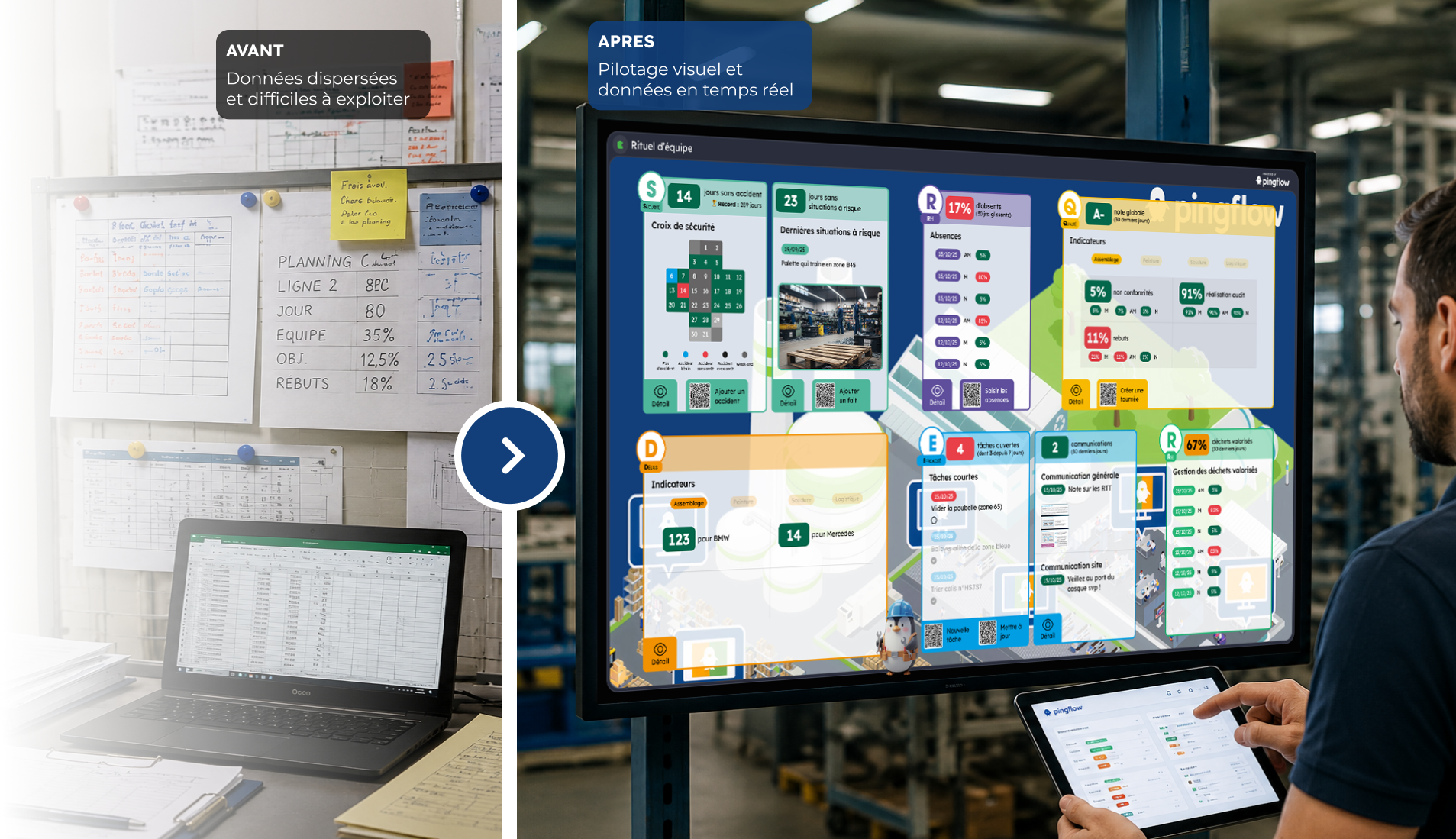
The wallboard for AIC (team rituals)
“The time we no longer spend building KPIs is spent on taking action.”
Looking back, David tells us that « the tool can be used by the operator, the team leader, the line manager » and that it allows us to « ensure that operators are always working with the latest qualified and validated products. » Wallboards are now the « main management tool, » and it is even « the operator who will come and challenge the improvement of the tool. »
His advice for this type of project:
- Involve users (don’t impose)
- and… take it step by step!
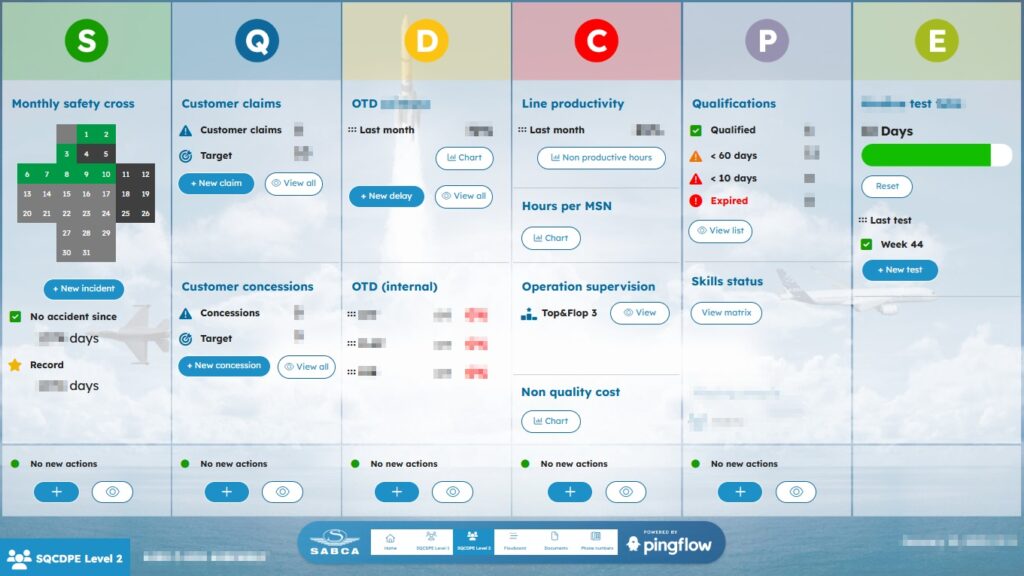
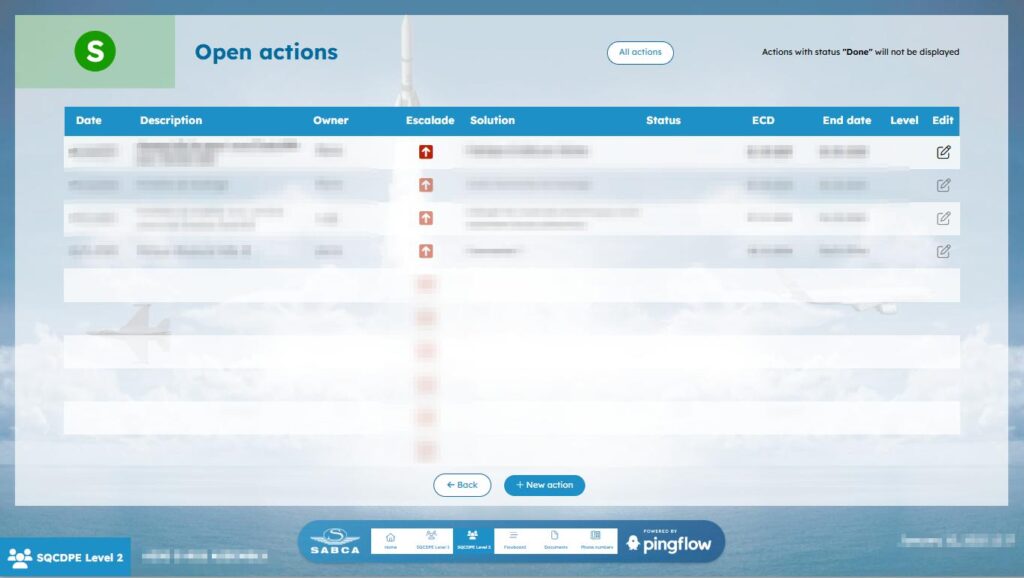
Simple checklists and escalation of actions from level 1 to level 2
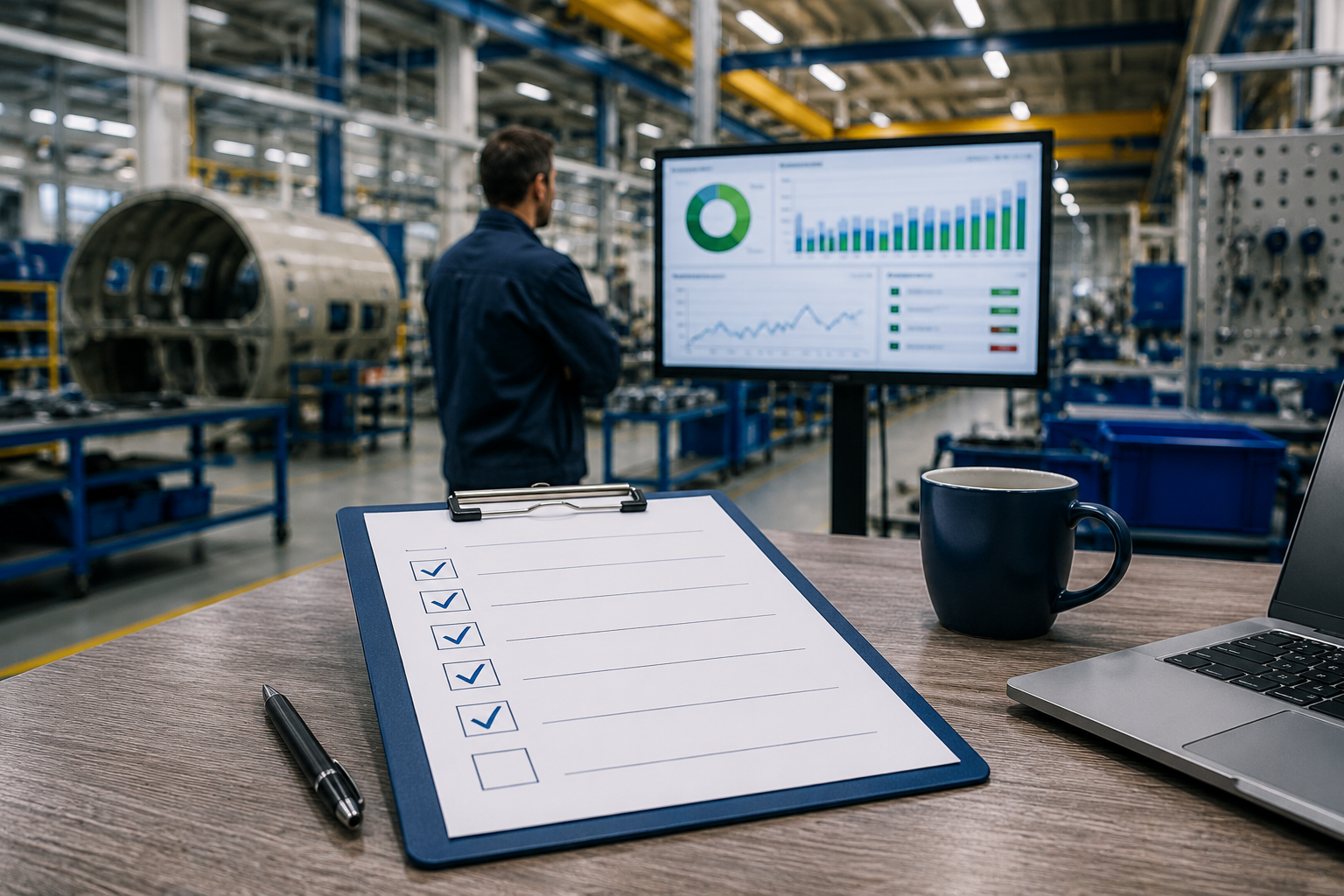
Checklists are a valuable tool for operators because they help them follow the steps of a process in a clear and organized manner. They help limit errors, especially in environments where tasks are complex or highly regulated by standards. By guiding operators step by step, they ensure that nothing important is overlooked, which improves safety, product quality, and compliance. They are also very useful for supporting newcomers.
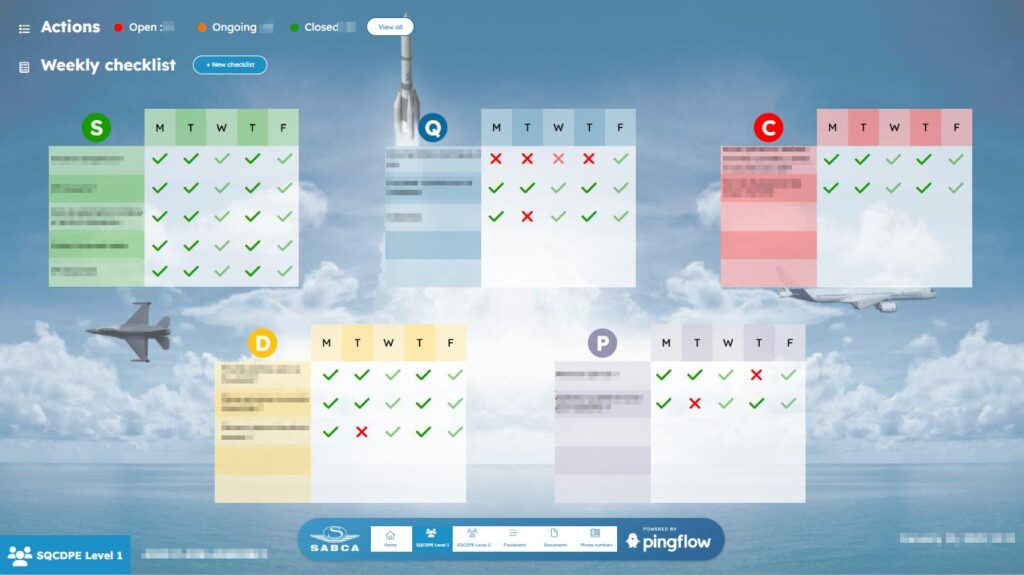
Different questions were designed for each section, and operators meet daily to complete the checklist and escalate actions to level 2. David tells us that « we can now escalate from the bottom to the top and from the top to the bottom » thanks to the tool. Digitizing this practice has made it possible to « reduce human error » and focus on taking actions during the level 2 ritual.